
QUASR Researchers Compare Latarjet Fixation Techniques in Biomechanical Study
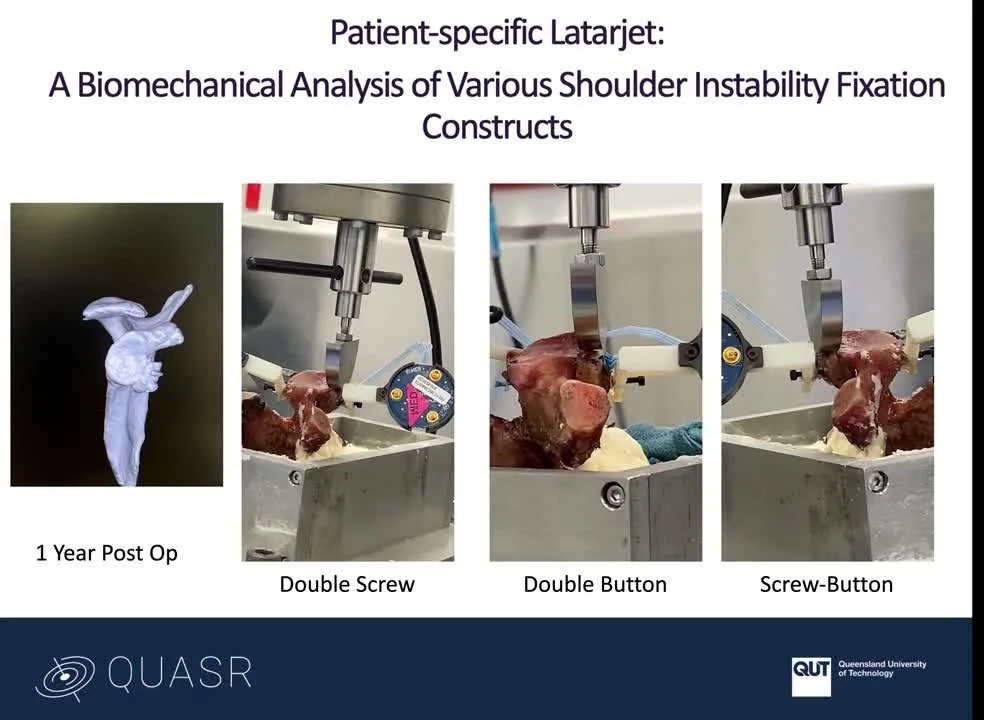
Investigating Fixation Options in the Latarjet Procedure
The Latarjet procedure is commonly used to address shoulder instability associated with significant glenoid bone loss. However, complications such as graft osteolysis, nonunion and fracture remain important considerations when selecting a fixation technique.
A research team from the Queensland Unit for Advanced Shoulder Research (QUASR) at Queensland University of Technology (QUT) investigated the biomechanical performance of three fixation constructs used in the Latarjet procedure: double-screw, double-button and combined screw-button fixation.
Published in the Journal of Shoulder and Elbow Surgery in 2023, the study, titled “A biomechanical analysis of double-screw, double-button, and screw-button fixation constructs in patient-specific instrument-guided Latarjet procedure,” explored whether combining a screw and a button could offer a balance between construct strength and controlled graft movement.
Comparing Three Fixation Constructs
Double-screw fixation is an established approach, offering strong initial fixation. However, concerns have been raised about stress shielding and its possible contribution to graft osteolysis.
Double-button fixation offers an alternative that allows greater movement at the graft interface, but concerns remain about its initial mechanical strength.
The research team investigated a combined approach using one screw and one button. The proposed construct was intended to retain some of the mechanical strength of screw fixation while allowing micromotion at the superior part of the graft.
The study compared:
Double-screw fixation: Two screws securing the coracoid bone graft.
Double-button fixation: Two button devices securing the graft.
Screw-button fixation: A combination of one screw and one button.
A Patient-Specific, Cadaveric Biomechanical Study
The study involved 40 scapulae from 20 fresh-frozen cadavers. Each specimen underwent computed tomography (CT) scanning, followed by a patient-specific instrument (PSI)-guided Latarjet procedure.
The researchers used a standardised testing protocol to compare the three fixation constructs. Specimens were subjected to cyclic loading before undergoing load-to-failure testing. The team assessed construct strength and graft displacement under mechanical loading.
The project required extensive preparation and coordination, including cadaver selection, preoperative CT imaging, patient-specific guide design and 3D printing, surgical procedures, biomechanical testing and post-implantation CT imaging. The resulting imaging data also provided a foundation for further finite element analysis (FEA).
What Did the Study Find?
The results demonstrated differences in the mechanical performance of the three constructs.
The double-screw construct had the highest average load to failure, at 537.8 N. The double-button construct failed at an average of 135.1 N, while the combined screw-button construct failed at an average of 283.5 N.
The screw-button construct required a significantly greater load to failure than the double-button construct. However, the double-screw construct showed less graft displacement during cyclic loading than either of the other two constructs.
These findings suggest that the combined screw-button technique may offer a useful alternative to double-button fixation, providing greater initial mechanical strength while allowing more graft displacement than the double-screw construct.
The researchers concluded that the screw-button construct has potential as an alternative fixation technique. However, the study examined biomechanical performance at a specific point in time and did not assess bone union or graft osteolysis directly. Further clinical research is therefore needed to establish its long-term outcomes.
A Collaborative Research Effort
The project represented three years of research and collaboration during the COVID-19 period. It brought together researchers and clinical expertise from QUASR and QUT, alongside contributions from the Herston Biofabrication Institute and industry support from Zimmer Biomet.
Prof Ashish Gupta acknowledged the dedication of the research team, particularly Brandon Ziegenfuss, whose leadership and commitment as a medical student were recognised as important contributions to the project.
The team also acknowledged the facilities provided by MERF and the support from Zimmer Biomet, including equipment and research resources.
Advancing Shoulder Research Through Collaboration
This study demonstrates how collaboration between clinicians, engineers and research institutions can help investigate important questions in shoulder surgery. By combining patient-specific instrumentation, CT-based planning and biomechanical testing, the QUASR team contributed evidence to the ongoing discussion around fixation strategies in the Latarjet procedure.
The findings provide a foundation for further investigation into how fixation design may influence graft stability and the potential complications associated with the procedure.
Original LinkedIn Post: View on LinkedIn