
QUASR Research Advances Vision-Guided Robotic Shoulder Arthroplasty
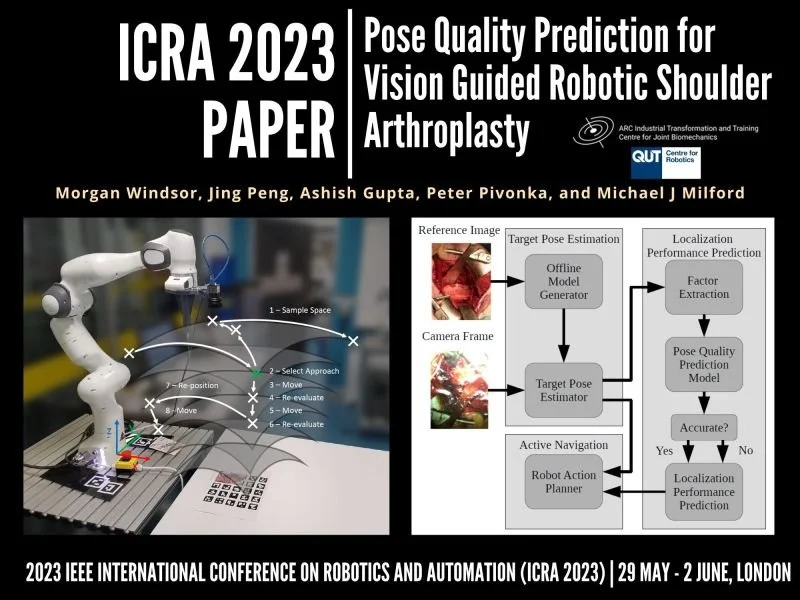
Improving Surgical Robot Navigation Through Pose Quality Prediction
Robotic-assisted shoulder arthroplasty relies on accurate localisation to help guide surgical instruments and support the execution of preoperative plans. However, the reliability of camera-based localisation systems can vary depending on the quality of visual information available during a procedure.
Researchers from Queensland University of Technology (QUT), associated with the Queensland Unit for Advanced Shoulder Research (QUASR) and robotics research teams, explored this challenge in a study presented at the 2023 IEEE International Conference on Robotics and Automation (ICRA) in London.
The research, titled Pose Quality Prediction for Vision Guided Robotic Shoulder Arthroplasty, was led by PhD researcher Morgan Windsor, with co-authors Jing Peng, Prof Ashish Gupta, Peter Pivonka and Michael J. Milford.
Understanding Pose Quality in Robotic Surgery
These technologies are particularly relevant to reverse shoulder arthroplasty, where accurate positioning and execution of the surgical plan are important considerations
In vision-guided robotic surgery, a localisation system uses camera-based information to estimate the position and orientation, or pose, of relevant objects within the surgical environment.
These estimates help the robot understand its position relative to the surgical target. However, not every localisation estimate is equally reliable.
The research addresses an important challenge: enabling a robotic system to assess the likely quality of its own localisation estimates rather than treating every estimate as equally accurate.
This capability can help identify potentially unreliable visual localisation information before it influences the robot's navigation decisions.
Key Research Developments
The study introduced methods designed to improve the reliability of vision-guided robotic navigation.
1. Predicting localisation quality
The researchers developed techniques that allow a localisation system to assess the likely quality of the estimates produced by a camera-based localiser in a surgical context.
2. Filtering unreliable estimates
By identifying and filtering out poor-quality localisation estimates, the system aims to improve the reliability of the position information available to the robot.
3. Improving robotic navigation paths
The research also explored how a robot can plan and execute navigation paths using information about when and where its localisation system is likely to perform well or poorly.
4. Supporting more reliable surgical navigation
The proposed methods demonstrated improvements in localisation performance and the likely success of robotic navigation paths towards a surgical target.
Collaboration Across Robotics and Shoulder Research
The research brought together expertise in shoulder surgery, robotics, computer vision and biomechanics.
Morgan Windsor led the research as a PhD student, working with Jing Peng, Prof Ashish Gupta, Peter Pivonka and Michael J. Milford.
The project received support from the ARC Training Centre for Joint Biomechanics, with contributions from the QUT Centre for Robotics and QUT Centre for Biomedical Technologies. The work was also supported through an Australian Research Council Laureate Fellowship and QUT's Strategic Major Equipment Program.
This collaboration demonstrates the value of bringing together clinical knowledge and engineering expertise to address challenges in robotic-assisted surgery.
Presenting the Research at ICRA 2023
The research was presented at the 2023 IEEE International Conference on Robotics and Automation (ICRA), held in London.
Morgan Windsor presented the work during the Medical Imaging and Perception III poster session, providing an opportunity to discuss the research with the international robotics and medical technology community.
ICRA provided a platform to share developments in vision-guided robotic surgery and explore further opportunities in surgical robotics research.
Advancing the Future of Robotic Shoulder Arthroplasty
Reliable localisation is an important consideration in robotic-assisted surgery. The ability to assess the quality of visual position estimates and use that information to guide navigation could help address challenges associated with camera-based robotic systems.
Through interdisciplinary research involving shoulder surgery, robotics and computer vision, the QUASR-associated research team continues to contribute to the development of technologies supporting the future of shoulder arthroplasty.
Original LinkedIn Post: View the LinkedIn Post